Wolkenmodell.de

Hello Thinking Cloud
Page Contents
1.
Selling Workflows to the Status Quo
2.
Necessity is the Mother of Invention
3.
The Art of Status Quo Maintenance
4.
The Ex is the New Best Practice
5.
Leveraging Informal Networks
6.
Utopia is Normally Over Budget
7.
Bureau Needs More Nice Things2Have
8.
Workflows That Actually Work
9.
Uphold the Status Quo
10.
Good Bye to the Thinking Cloud Model
Selling Workflows to the Status Quo
This project started as a creative prototype: the Thinking Cloud Model, a method to unite people – not in a spiritual way, and neither with rhetoric. In my role as an IT sales territory manager for a German industrial digitizer machine company, I was supposed to deliver genuine solutions to big corporations. I approached the task with empathy inspired by Gandhi's methods, because dynamism was needed for the USPs I was aiming for. I was up to the task with my particular creativity, but without offending the nitpickers, bean counters, or the engineers. I saw my role more as that of a Key Account Manager for big clients: companies like VW, Arvato, Nielsen, and German Government State Departments – including the one implicated in sending an innocent man to Guantanamo. And some of my Key Accounts, were known by the Base-Level Workers! Sometimes the situation was really bad when you heard some of them, just like outsourcers, bragging about how cruel they can be to the employees, even some of my sales colleagues not only put up with it but agreed with it, they even made fun of them contemptuously. Of course, I had to hide a concept that implies humanity. So, I needed a tool to improve the situation for as many souls as possible, but one that genuinely achieved optimization in the shark tank. So, I used a technique to add value to the achievements of underrated individuals, like designing USPs with their help. For those who are not familiar with USPs, it’s the unique aspect of a product design that gives you an advantage in comparison to another product. Obviously, it’s a Unique Selling Point, short: USP, but just as American products are often a symbol of freedom and ingenuity or German products are known for their precision and quality, a USP can also contain a certain value. In this spirit, I designed a unique model for product development to add value. To give an example, the concept of Open Source values the individual behind the code more than a closed-source model does and the whole product gains value from the many human sources. Therefore, the individual is more appreciated and is less likely to be outsourced, unlike in a closed-source model. Does this make sense? So, this isn’t new, but there is no transfer concept I know between those two worlds.Necessity is the Mother of Invention
The 'Thinking Cloud' was born out of necessity; necessity made it viable. How? By putting free-flowing thoughts of the stakeholders onto structure, like imagining goals with clouds, thereby allowing the resulting product to become easy to achieve, instead of being overwhelming due to utopian ideals.The Art of Status Quo Maintenance
The existing Status Quo is important and can be used as a framework. How? By letting things run naturally, with a conceptual test run as part of the Thinking Cloud Model, and recognizing everything that is present ('what's given'), even if it contradicts the standard 'textbook' workflow. Instead of fighting it, use it. It’s kind of like a Stress Test upfront. It helps to get acquainted with the specific unknown variables of each client.The Ex is the New Best Practice
For instance, there was an ex-IT Consultant at a large insurance corporation whom former colleagues from other departments kept asking for his expertise, even after he became the CEO of an IT subsidiary of this corporation, but with completely different tasks that weren't tied to the old workflows anymore. This wasn't how things were formally meant to be, but that was the actual situation – the Status Quo. So why fight it?Leveraging Informal Networks
Therefore, I contacted him too. He was a nice, genuine guy, and I utilized his expertise as a mentor, even though I wasn't in the same 'team' as an external salesman. But he was very openminded, I instantly understood why he was such a treasure. I think he felt this was mutual either, my argument was that using his expertise for development was in the best interest of all 'my' actual participants, whom he genuinely cared about. This approach is what makes the 'Thinking Cloud' Model very empirical and realistic.Utopia is Normally Over Budget
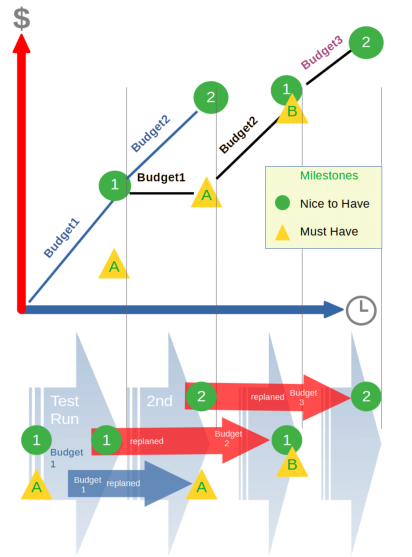
This is the way; my Best Practice was about including established habits with realistic new improvements, so they don't come 'out of the blue'. The Thinking Cloud establishes only a small baseline of 'Must-Haves' for the initial run; it’s like a Stress Test. By setting short milestones, it allows everything to be evaluated and measured for effort and time. It helps define what is really needed, and anything beyond that can be truly appreciated as 'Nice-to-Haves'. Usually, the test run is paid for by the client, but already with small, achievable 'Must-Haves' (and 'Nice-to-Have' features often weren’t immediately necessary), a green light for the budget was easy to get. Once the first milestone was achieved, the next budget could be used, for example, for a 'Must-Have' solution and also a 'Nice-to-Have' feature. With this buffer, and by measuring the real effort during the runs, a more realistic budget can be contracted. Even extending the budget was very easy because the USPs were already brainstormed as 'Nice-to-Haves'. A win-win for both sides! Through this, everything can be achieved. This approach is more budget- friendly than aiming for a 'full-blown utopia' on paper, perhaps sold to a CEO at the golf club, after which nothing works and more budget is constantly needed. This scenario represents a very common failure. I wonder if BER, Stuttgart 21, and the Elbphilharmonie are somehow related to the same systemic causes; it was definitely not realistic planning. Is the cause related to a psychological layer, missing communication, and empathy?Bureaucracy Needs More Nice Things to Have
There are very valuable Best Practices out there already, you just have to pick the fruits, what is Nice to Have…Imagine a bureaucratic system that is funded by public money and actually creates common goods and inspires others, other Departments or Governments, without being overly restrictive or 'clingy' – delivering true public value with Open Source, or just open the code for customization. Besides, the development or customization figures can be shared because different government departments shouldn’t compete; but in Germany due to the federal system, they do. They shall work together! These are 'Nice-to-Have' things, and it adds to a contract design for the future nicely with 'Nice-to-Have' things. Needs often leads to concrete imaginations, at any level, from the Base-Level Worker to Management. It's just waiting to be asked. And Thinking Cloud puts all that together, piece by piece, as already illustrated.Designing Workflows That Actually Work
Instead of forcing everything into a standard textbook framework, designing an optimized workflow for each task allows more room for specific needs. And if it's realized that Base-Level Workers or Managers can identify with their own working tools, once they've experienced having a say, the chances are good this communication is going to repeat. It's a responsive positive feedback loop. This allows for more optimization and is more ergonomic. It allows organizational Status Quo for applying different new technology concepts and adapting to different types of company organizational forms for tasks, like at VW around 2015, e.g., a USP being the use of a search engine rather than a DMS for long-term archiving. Of course, by injecting USPs, it's in the best interest of both the company and the contractor to defend a position/project slot that has to be formally tendered by EU law. Not Project Management, but Stakeholder Engagement So the 'Thinking Cloud' Model isn't a Project Management tool; remember, it was wise to use it hidden in the shark tank. Nevertheless, it results in something emerging that encompasses the bigger picture, and it's more of a Stakeholder Engagement tool. Remember I asked if there is general communication in many big companies. TC prioritizes not just classic Stakeholder interests but genuine human opinions at all levels, including the Base-Level Worker. It's not revolutionary; it's simply logical. But later I will show, this is also a matter for National Security!Uphold the Status Quo (Until It Explodes)
It's not about moving away from rigid requirements documents or toxic leadership hierarchies. No worry, the Status Quo will be upheld! No matter what, the Status Quo is seen to represent the Best Practices and interests of the majority, including lower levels. Everything can be overseen by everyone, so the purpose of Documentation and leading Project Management can be eased up. This logical argument holds particular weight for Middle Management stuck between the lines in strongly hierarchical structures with a distanced relationship to both the Top and the Base Levels. No wonder things went wrong with Dieselgate. The 'Thinking Cloud' Model could potentially have prevented that. Simply put, the consideration of all reachable ideas in harmony with the Status Quo, projected into the clouds and then realized through evaluations, constitutes a kind of ‘Emergence’. Beyond the known 'Best Practices', using the 'Thinking Cloud' allows what everyone really wants to emerge. Something Gandhi also achieved: a multi-win situation with Truth and Empathy. One of my first insights to get acquainted with Client Management before a Stress Test was always to consult the Base – no, I am not Gandhi, but I do try to find USPs. This was simply my job. And it’s simple: talk to the Front-Line Workers to be heard and get to know the former IT Consultant I mentioned before. I liked it to meet so many great people.Good Bye to the Thinking Cloud Model
it's time to say it's obsolete! Sadly :( sniff And I am SOOOO sorry its NOT that Simple: True Emergence transforms chaos into structure, you wish ;) Empowering instead of causing tears or riots, tired of monocultures in rainforests or boardrooms, CSR statements that are hollow, "innovation" meaning bringing back nuclear power that no one needs. Let’s get real: even the finest wine tastes bad if the foundation is crumbling. So let’s talk about the next chapter – on the next page. Spoiler: It’s about AI, why it's not about God, and why you might (not) be such a villain after all. More on memocide.de about True Emergence But if you wish to know WHY Thinking Cloud is obsolete read here oder in German / Deutsch warum das Wolkenmodell obsolete ist







Thinking Cloud
12min AI Podcast

Site Version 1.5.1-6-doc


Wolkenmodell.de



Hello Thinking Cloud
Page Contents
1.
Selling Workflows to the Status Quo
2.
Necessity is the Mother of Invention
3.
The Art of Status Quo Maintenance
4.
The Ex is the New Best Practice
5.
Leveraging Informal Networks
6.
Utopia is Normally Over Budget
7.
Bureau Needs More Nice Things2Have
8.
Workflows That Actually Work
9.
Uphold the Status Quo
10.
Good Bye to the Thinking Cloud Model
Selling Workflows to the Status Quo
This project started as a creative prototype: the Thinking Cloud Model, a method to unite people – not in a spiritual way, and neither with rhetoric. In my role as an IT sales territory manager for a German industrial digitizer machine company, I was supposed to deliver genuine solutions to big corporations. I approached the task with empathy inspired by Gandhi's methods, because dynamism was needed for the USPs I was aiming for. I was up to the task with my particular creativity, but without offending the nitpickers, bean counters, or the engineers. I saw my role more as that of a Key Account Manager for big clients: companies like VW, Arvato, Nielsen, and German Government State Departments – including the one implicated in sending an innocent man to Guantanamo. And some of my Key Accounts, were known by the Base-Level Workers! Sometimes the situation was really bad when you heard some of them, just like outsourcers, bragging about how cruel they can be to the employees, even some of my sales colleagues not only put up with it but agreed with it, they even made fun of them contemptuously. Of course, I had to hide a concept that implies humanity. So, I needed a tool to improve the situation for as many souls as possible, but one that genuinely achieved optimization in the shark tank. So, I used a technique to add value to the achievements of underrated individuals, like designing USPs with their help. For those who are not familiar with USPs, it’s the unique aspect of a product design that gives you an advantage in comparison to another product. Obviously, it’s a Unique Selling Point, short: USP, but just as American products are often a symbol of freedom and ingenuity or German products are known for their precision and quality, a USP can also contain a certain value. In this spirit, I designed a unique model for product development to add value. To give an example, the concept of Open Source values the individual behind the code more than a closed-source model does and the whole product gains value from the many human sources. Therefore, the individual is more appreciated and is less likely to be outsourced, unlike in a closed-source model. Does this make sense? So, this isn’t new, but there is no transfer concept I know between those two worlds.Necessity is the Mother of Invention
The 'Thinking Cloud' was born out of necessity; necessity made it viable. How? By putting free-flowing thoughts of the stakeholders onto structure, like imagining goals with clouds, thereby allowing the resulting product to become easy to achieve, instead of being overwhelming due to utopian ideals.The Art of Status Quo Maintenance
The existing Status Quo is important and can be used as a framework. How? By letting things run naturally, with a conceptual test run as part of the Thinking Cloud Model, and recognizing everything that is present ('what's given'), even if it contradicts the standard 'textbook' workflow. Instead of fighting it, use it. It’s kind of like a Stress Test upfront. It helps to get acquainted with the specific unknown variables of each client.The Ex is the New Best Practice
For instance, there was an ex-IT Consultant at a large insurance corporation whom former colleagues from other departments kept asking for his expertise, even after he became the CEO of an IT subsidiary of this corporation, but with completely different tasks that weren't tied to the old workflows anymore. This wasn't how things were formally meant to be, but that was the actual situation – the Status Quo. So why fight it?Leveraging Informal Networks
Therefore, I contacted him too. He was a nice, genuine guy, and I utilized his expertise as a mentor, even though I wasn't in the same 'team' as an external salesman. But he was very openminded, I instantly understood why he was such a treasure. I think he felt this was mutual either, my argument was that using his expertise for development was in the best interest of all 'my' actual participants, whom he genuinely cared about. This approach is what makes the 'Thinking Cloud' Model very empirical and realistic.Utopia is Normally Over Budget
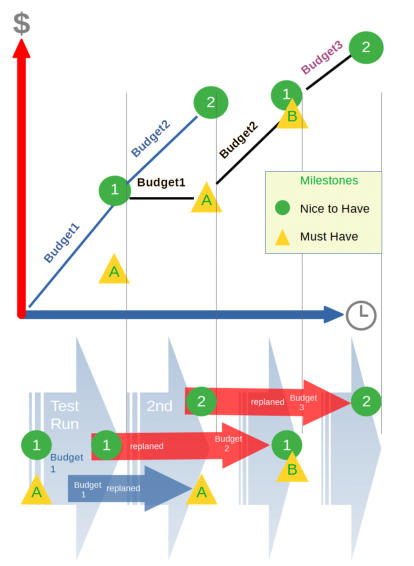
This is the way; my Best Practice was about including established habits with realistic new improvements, so they don't come 'out of the blue'. The Thinking Cloud establishes only a small baseline of 'Must-Haves' for the initial run; it’s like a Stress Test. By setting short milestones, it allows everything to be evaluated and measured for effort and time. It helps define what is really needed, and anything beyond that can be truly appreciated as 'Nice-to-Haves'. Usually, the test run is paid for by the client, but already with small, achievable 'Must-Haves' (and 'Nice-to-Have' features often weren’t immediately necessary), a green light for the budget was easy to get. Once the first milestone was achieved, the next budget could be used, for example, for a 'Must-Have' solution and also a 'Nice-to-Have' feature. With this buffer, and by measuring the real effort during the runs, a more realistic budget can be contracted. Even extending the budget was very easy because the USPs were already brainstormed as 'Nice-to-Haves'. A win-win for both sides! Through this, everything can be achieved. This approach is more budget- friendly than aiming for a 'full-blown utopia' on paper, perhaps sold to a CEO at the golf club, after which nothing works and more budget is constantly needed. This scenario represents a very common failure. I wonder if BER, Stuttgart 21, and the Elbphilharmonie are somehow related to the same systemic causes; it was definitely not realistic planning. Is the cause related to a psychological layer, missing communication, and empathy?Bureaucracy Needs More Nice Things to
Have
There are very valuable Best Practices out there already, you just have to pick the fruits, what is Nice to Have…Imagine a bureaucratic system that is funded by public money and actually creates common goods and inspires others, other Departments or Governments, without being overly restrictive or 'clingy' – delivering true public value with Open Source, or just open the code for customization. Besides, the development or customization figures can be shared because different government departments shouldn’t compete; but in Germany due to the federal system, they do. They shall work together! These are 'Nice-to-Have' things, and it adds to a contract design for the future nicely with 'Nice-to-Have' things. Needs often leads to concrete imaginations, at any level, from the Base-Level Worker to Management. It's just waiting to be asked. And Thinking Cloud puts all that together, piece by piece, as already illustrated.Designing Workflows That Actually Work
Instead of forcing everything into a standard textbook framework, designing an optimized workflow for each task allows more room for specific needs. And if it's realized that Base-Level Workers or Managers can identify with their own working tools, once they've experienced having a say, the chances are good this communication is going to repeat. It's a responsive positive feedback loop. This allows for more optimization and is more ergonomic. It allows organizational Status Quo for applying different new technology concepts and adapting to different types of company organizational forms for tasks, like at VW around 2015, e.g., a USP being the use of a search engine rather than a DMS for long-term archiving. Of course, by injecting USPs, it's in the best interest of both the company and the contractor to defend a position/project slot that has to be formally tendered by EU law. Not Project Management, but Stakeholder Engagement So the 'Thinking Cloud' Model isn't a Project Management tool; remember, it was wise to use it hidden in the shark tank. Nevertheless, it results in something emerging that encompasses the bigger picture, and it's more of a Stakeholder Engagement tool. Remember I asked if there is general communication in many big companies. TC prioritizes not just classic Stakeholder interests but genuine human opinions at all levels, including the Base-Level Worker. It's not revolutionary; it's simply logical. But later I will show, this is also a matter for National Security!Uphold the Status Quo (Until It Explodes)
It's not about moving away from rigid requirements documents or toxic leadership hierarchies. No worry, the Status Quo will be upheld! No matter what, the Status Quo is seen to represent the Best Practices and interests of the majority, including lower levels. Everything can be overseen by everyone, so the purpose of Documentation and leading Project Management can be eased up. This logical argument holds particular weight for Middle Management stuck between the lines in strongly hierarchical structures with a distanced relationship to both the Top and the Base Levels. No wonder things went wrong with Dieselgate. The 'Thinking Cloud' Model could potentially have prevented that. Simply put, the consideration of all reachable ideas in harmony with the Status Quo, projected into the clouds and then realized through evaluations, constitutes a kind of ‘Emergence’. Beyond the known 'Best Practices', using the 'Thinking Cloud' allows what everyone really wants to emerge. Something Gandhi also achieved: a multi-win situation with Truth and Empathy. One of my first insights to get acquainted with Client Management before a Stress Test was always to consult the Base – no, I am not Gandhi, but I do try to find USPs. This was simply my job. And it’s simple: talk to the Front-Line Workers to be heard and get to know the former IT Consultant I mentioned before. I liked it to meet so many great people.Good Bye to the Thinking Cloud Model
it's time to say it's obsolete! Sadly :( sniff And I am SOOOO sorry its NOT that Simple: True Emergence transforms chaos into structure, you wish ;) Empowering instead of causing tears or riots, tired of monocultures in rainforests or boardrooms, CSR statements that are hollow, "innovation" meaning bringing back nuclear power that no one needs. Let’s get real: even the finest wine tastes bad if the foundation is crumbling. So let’s talk about the next chapter – on the next page. Spoiler: It’s about AI, why it's not about God, and why you might (not) be such a villain after all. More on memocide.de about True Emergence But if you wish to know WHY Thinking Cloud is obsolete read here oder in German / Deutsch warum das Wolkenmodell obsolete ist
Thinking Cloud
12min AI Podcast